
Technical Articles
NANBEI Is Professional On Providing One-step Solution Of Laboratory Instruments And Equipment
Clinics, research labs, and small-to-mid-size hospitals shopping for a mid-capacity autoclave usually land on the same shortlist of questions: how much can it actually hold, how fast is a real sterilization cycle, and what fails first after a year of daily use? The <LS-75HD 75L Hand Round Automatic Vertical Pressure Steam Sterilizer is built specifically for that mid-volume segment — larger than a benchtop unit, smaller and simpler to operate than a horizontal cylindrical sterilizer sized for a full hospital central supply department. This article walks through the unit's actual technical data, how the sterilization cycle works step by step, and the details worth confirming before placing an order.
Nanbei's vertical pressure steam sterilizer line runs from 35L to 100L, and the LS-75HD is the third step up: a 75-liter chamber, φ400×600mm, positioned between the LS-50HD for smaller clinics and the LS-100HD for higher-throughput settings. All four models in the automatic ("HD") series share the same core architecture — hand-wheel quick-open door, digital touch-key display, and automatic pressure/temperature control — so the real decision between them usually comes down to daily instrument volume rather than feature differences. For reference, the 35L and 50L models run at a higher 0.22MPa working pressure and 134°C cycle temperature, while the 75L and 100L models step down to 0.14MPa and 126°C — a distinction worth understanding rather than assuming is a size-only change, since it affects both cycle time and material compatibility.
The LS-75HD's chamber measures 75 liters (φ400×600mm) and operates at a working pressure of 0.14MPa with a maximum working pressure of 0.165MPa, holding a working temperature of 126°C. Temperature uniformity is held to ≤±1°C across the chamber, and the built-in timer covers a 0–99 minute or 0–99 hour 59 minute range depending on cycle requirements, with temperature adjustable from 105°C to 126°C for different load types. Power draw is 4.5kW at AC220V/50Hz. The unit's overall footprint is 560×560×1120mm, with a transport dimension of 650×630×1280mm; gross weight is 100kg and net weight 80kg. The full pressure vessel is constructed from 3mm-thick 304-grade (SUS304/AISI 304) stainless steel — a detail that matters more than it might first appear, since vessel-grade stainless directly affects corrosion resistance under repeated steam cycling and is one of the first things a quality-conscious buyer should verify against the supplier's mill certificate rather than take on faith from a spec sheet.
Understanding the cycle sequence helps explain why several of the LS-75HD's safety features exist in the first place, rather than treating them as a checklist. After the load is placed inside and the hand-wheel door is sealed against the self-inflating gasket, the unit's automatic air discharge system purges cool air from the chamber — a necessary step, because residual air pockets prevent steam from reaching every surface of the load and are one of the most common causes of incomplete sterilization in poorly designed or poorly operated autoclaves. Once air discharge is complete, the chamber pressurizes and heats toward the set point (up to 126°C for the LS-75HD), held for the programmed dwell time on the digital timer. At the end of the cycle, steam is discharged automatically rather than requiring manual venting, and the unit shuts off with an audible beep to signal completion — reducing the chance of an operator opening the door too early or leaving a finished load unattended under residual pressure.
Several protection systems run throughout this sequence rather than only at the end: over-temperature and over-pressure auto-protection interrupts the cycle if either value exceeds safe limits, a water-shortage protection system prevents dry-running if the water reservoir runs low mid-cycle, and the door safety lock system mechanically prevents the door from being opened while the chamber remains pressurized. Together, these systems are what separate an automatic sterilizer from a simple pressure cooker with a timer — the automation exists specifically to catch the failure modes that cause equipment damage or incomplete sterilization when a cycle is left unsupervised.
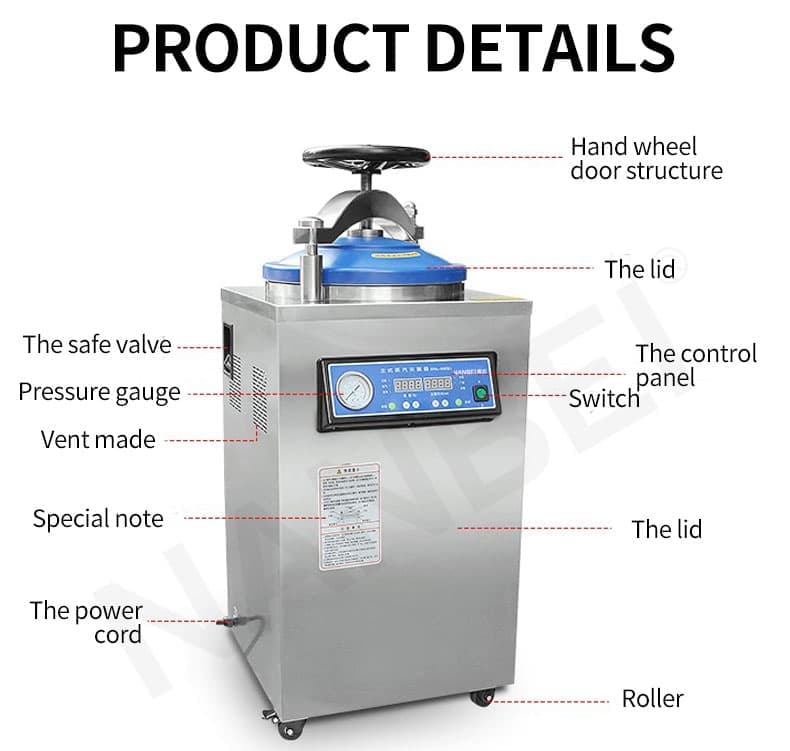
Beyond the headline "fully stainless steel" spec, buyers sourcing for institutional use should confirm a few specific points with the supplier before finalizing an order: the grade and thickness of the pressure vessel steel (304/3mm on the LS-75HD, as noted above), whether the door gasket is a genuine self-inflating type rated for repeated high-pressure cycling rather than a static seal, and the warranty term — Nanbei backs this model with a 24-month warranty. It's also worth asking specifically whether a drying system can be factory-installed, since the LS-75HD supports this as an optional configuration; instruments that come out of the chamber still damp are more prone to post-sterilization contamination during handling and storage, so buyers processing textiles or wrapped instrument sets in particular should weigh whether the drying option is worth the added cost for their workflow.
A common sourcing mistake is selecting chamber volume based on available floor space rather than actual daily instrument load. A clinic running a handful of sterilization cycles per day rarely benefits from jumping straight to the 100L model, since larger chambers take proportionally longer to come up to pressure and temperature for a partial load, which can waste both cycle time and energy on off-peak days. Conversely, undersizing forces multiple cycles per day where one would otherwise suffice, increasing both labor time and wear on the door seal and heating elements from repeated cycling. The 75L capacity of the LS-75HD is generally well matched to small hospital departments, group clinical practices, and research labs running moderate daily instrument volume — enough capacity to batch a full tray set per cycle without the footprint or power draw of the 100L unit.
For buyers importing into regulated healthcare markets, documentation matters as much as the spec sheet itself. Sterilizers used on medical instruments typically require region-specific conformity evidence beyond a general CE mark — in GCC markets, this generally means confirming GSO (Gulf Standards Organization) conformity assessment status alongside any CE documentation, since medical and healthcare-adjacent equipment is frequently subject to additional scrutiny at customs compared to general lab equipment. In ASEAN markets, requirements vary by country, and some jurisdictions classify autoclaves used for medical instrument reprocessing as regulated medical devices requiring local registration rather than general equipment import, so it's worth confirming device classification with the destination country's health authority before shipment rather than assuming lab-equipment import procedures apply. Buyers should request current certification documents — CE, and any applicable ISO quality system certification — directly from the supplier as part of the purchase order process.
The LS-75HD rarely operates in isolation in a working lab or clinic. Facilities managing a broader instrument and consumables workflow often pair it with a infrared heat sterilizer for glassware or small-tool dry-heat sterilization where steam cycling isn't appropriate, and a clean bench for maintaining a sterile handling environment once instruments come out of the autoclave. Labs also sourcing broader capacity or different door configurations can compare the full range on the Steam Sterilizer category page, which includes the related 100L hand-round model and other vertical, table-top, and horizontal cylindrical configurations within the same product family.
The LS-75HD's real value for buyers isn't the headline 75-liter figure — it's the combination of a correctly sized 304-stainless chamber, a fully automatic pressure/temperature/discharge cycle with layered safety protections, and a 24-month warranty backing a design built specifically for mid-volume clinical and lab use. Confirming vessel-grade steel, gasket type, optional drying configuration, and destination-market compliance documentation before ordering avoids the most common sourcing mistakes in this equipment category. Full technical specifications and related model comparisons are available on the LS-75HD product page.